
People always ask me about coil vs rotary tattoo machines, and I got to dig into exactly that on a podcast recently. I build machines one at a time here in San Diego, and I've been tattooing since 1998, so it's a question I think about a lot. Ricardo, a Brazilian tattooer living and working in Germany, hosts Under the Skin: The Tattoo Podcast, and this was his first episode of the year and his first one in video. He's a really great host. He made the whole thing comfortable, so it turned into an easy, honest conversation instead of a stiff interview. It was my first podcast, so a little nerve-wracking, but I'm glad I did it.
The episode is part of Under the Skin: The Tattoo Podcast, available on Spotify.
Coil vs Rotary Tattoo Machines: How They Really Differ
A lot of the conversation was about machines and how they really work. Coils, and how pens and rotaries changed the way people tattoo. There's a lot gained with the newer tools, but there's stuff that gets lost too, and I think understanding what your machine is actually doing still matters if you want to tattoo well over the long haul. You don't have to build your own, but knowing why a machine runs the way it does makes you better at using it.
When it comes to coil vs rotary tattoo machines, I lean toward coils, and part of that is just that I know how to tinker with them. But I also think they give you more feeling and more feedback. You can hear what the machine is telling you, and when you're in the skin you have way more sense of how deep you are. The real beauty of a coil is that you can set it up for your own hand. Years ago I met Horoshi and asked him about his machine, and he told me he could answer every question I had, but I'd never tattoo with it the way he does, because it was set for his hand and not mine. That stuck with me.
How I build a machine
We also got into machine building from the inside: tuning, materials, geometry, and breaking a machine in through actual tattooing. I build mine one at a time. I'm not churning out frames, and honestly I don't want to. I build one, break it in by tattooing with it, and I don't move on until it runs the way I want. I come at it as a tattooer first and a builder second. The machine has to work on skin, not just look good on a bench or a spec sheet.
That's also why I lean handmade over store-bought. A production machine is fine, but they just feel more store-bought to me, if that makes sense. And there's no such thing as a perfect machine that does everything. Every build is a set of choices for a certain kind of work.
I started building from scratch around 2009, though before that we were always buying coil machines, taking them apart, and putting them back together just to understand them. I learned mostly through trial and error, plus the old Machine Gun magazine, some of Danny Fowler's videos, and whatever tricks I could pick up from the machine guy every shop used to have. A couple of friends and I got into it around the same time out here in San Diego. If you ask me what makes a good machine, it comes down to the geometry and the materials it's made of. The guy who taught me used to say there's no such thing as a bad machine, only bad parts, and there's a lot of truth to that. Get the coils square and flat, use good iron, run a frame that isn't twisted, and it'll run.
One thing that surprises people: most machines get ruined by over cleaning, not neglect. Guys scrub and soak them to death. A machine you understand and maintain with a light hand will outlast one that gets fussed over. I've got a set of machines I bought over twenty years ago and never messed with, same springs and all, and they still run smooth. Most of the machines people send me to fix just need the contact screw turned in a couple times.
We also got into drawing and making your own supplies. Drawing is the foundation of all of it for me, and it feeds everything else I make. Building machines is really just an extension of that same instinct. I like making the things I use, whether it's a machine, a nib holder, or a sheet of flash. When you make your own tools, you understand them in a way you can't buy, and that understanding ends up in the tattoo.
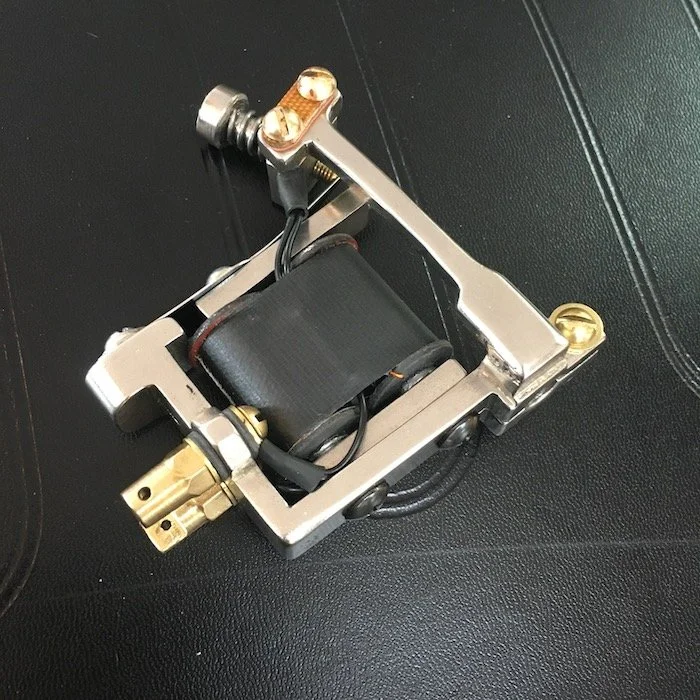
Hand made Deitzel replica machine I made a couple years ago
Prefer to listen? the audio is above.
Tattooing as a trade
The other half of the conversation was about tattooing as a trade. We talked about where and when I started, how I came up through apprenticeships, and how things have shifted with the advent of tattoo schools. A traditional apprenticeship is a different animal. Some shops only take apprentices to train their own artists their own way, and there's a reason for that. You're not just learning to tattoo, you're learning the trade, the responsibility, the culture that comes with it.
Shop culture in the 90s was a different world than today. Tattooing used to be something you had to earn, and now it often looks easier than it really is. That's not me being nostalgic for its own sake. It's just that shortcuts usually come with a cost, and you can see it in the work.
Wearing tattoos was different back then too. In the early 90s there was a real stigma around it in certain parts of the country, and I was living in Texas. A small tattoo was fine, but larger work, and definitely hand and face tattoos, could genuinely hold you back in life. That's a big part of why I moved to California. There were just more options out here, for the work and for living a tattooed life without it closing doors on you.
Cartridges, safety, and health guidelines
We also spent real time on membrane cartridges, where they came from, and how they changed the safety side of tattooing. People love to argue about how clean they are, and one thing worth clearing up: the membrane isn't really a filter, it's a seal. It seals everything off unless it physically breaks. Cheyenne is one of the only companies I know of that actually lab-tested and certified their membranes, and there's a Canadian guideline that says if you want to check one yourself, you pump liquid through it fifty times and look for backfill. If a membrane does break, the rule I could find just called for sanitizing the back of the machine, not full autoclave sterilization.
Cartridges themselves aren't even that new. The tech goes back to around 1982 in cosmetic tattooing under a different name, before it got rebranded for us. Back in my 2008 bloodborne pathogens classes they told us flat out not to use pens, and showed us the gross insides of pre-membrane cosmetic machines, so the membrane really was a genuine step forward. These days I look for machines that come completely apart, like the Bishops, so you can pull the motor and autoclave the housings. Safety is part of the trade, not an afterthought, and keeping up with the guidelines is just part of doing this responsibly.
Why the tools matter
The longer you stay in tattooing, the more your tools shape how you think and work. Familiarity is its own kind of skill. When you're not fighting your equipment, you can put all your attention on the tattoo. That was the thread running through the whole thing: the tools, the trade, and how both change the longer you do this. In the end, the whole coil vs rotary tattoo machines argument matters less than knowing your tools.
If you want to see the machines I build, they're here: Tattoo Machines.