
Crazy Sal Tattoo Origin: The Story of the Rough Rider Skull
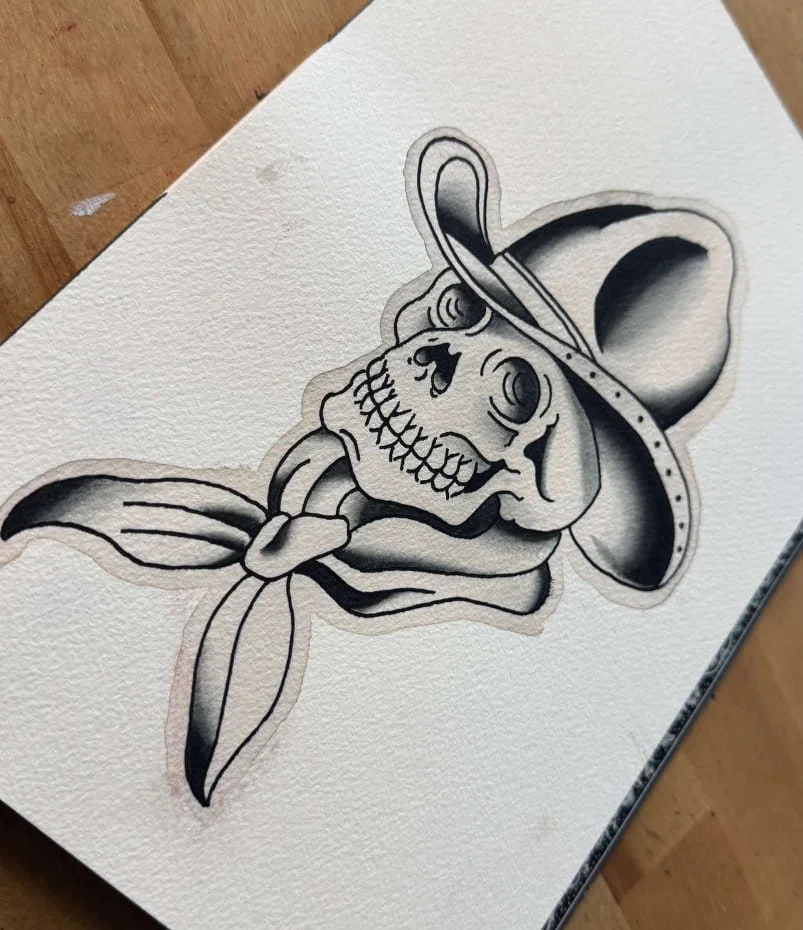
Hand painted flash of the famous Rough Rider skull drawn from the book “Death on a Dude Ranch”
The Rough Rider tattoo, often called the Crazy Sal tattoo, predates a 1980 Brooklyn crime. Tattooer Tony Polito referred to the design as "Rough Rider." The "Crazy Sal" name came from newspaper coverage after the suspect’s arrest photo showed the tattoo. The image itself has earlier roots in pulp illustration and traditional tattoo flash.
In 1980, a Brooklyn murder suspect was photographed in police custody. He was shirtless. On his chest was a killer tattoo from legendary Brooklyn tattoo artist Tony Polito.
The newspapers ran the image and this almost instantly became known as the "Crazy Sal Tattoo".
This is the story of how a single press photo reshaped the identity of a traditional design, and maybe where it originated.
The Crime That Changed the Name
Salvatore DeSarno, nicknamed "Crazy Sal," was on parole for a 1978 armed robbery in which he robbed a 60-year-old woman at knifepoint. Not long after on January 28, 1980, he shot NYPD officer Cecil Sledge four times during a traffic stop in Brooklyn. He then ran Sledge over and dragged for half a mile. DeSarno had been wanted for questioning in connection with a donut shop robbery and had reportedly been seen brandishing a pistol prior to the stop. Sledge was wearing a bulletproof vest, but after being shot, run over, and dragged beneath DeSarno’s car, he later died in the hospital from his injuries.
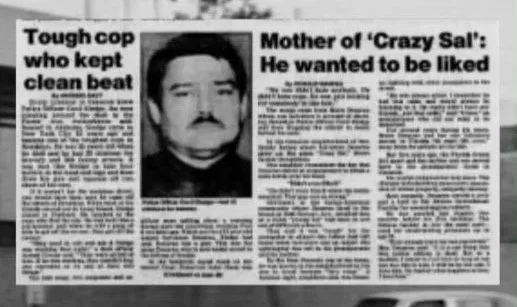
Headline from a paper after the crime.
After crashing his vehicle into a house on Avenue I, DeSarno entered the residence, took 50-year-old homeowner Marion Mazer hostage, and barricaded himself inside before eventually surrendering to police.
The story dominated local headlines. One particular photograph of DeSarno being escorted in custody, the skull tattoo on his chest, elevated this design to instant recognition.
From that moment on, many began referring to the design as the "Crazy Sal" skull.
He was convicted in 1981 and sentenced to 25 years to life. Multiple parole hearings, including 2012 and 2018, resulted in denial of release, and he remains incarcerated.
What Tony Polito Called It
Legendary Brooklyn tattooer Tony Polito had been tattooing since 1959. He may not have invented the image, but he refined and named the version that became dominant today.
Polito often called the design "Rough Rider".
Not the Crazy Sal tattoo.
Why Rough Rider?
Because the name fits, and may have helped separate the design from the crime it became tied to in the press.
"Roosevelt's Rough Riders”
The phrase "Rough Riders" most famously refers to Theodore Roosevelt’s volunteer cavalry regiment during the Spanish–American War in 1898. The term became part of American frontier mythology. It was a common theme in artwork, books, ads and recruitment media.
However, the skull artwork itself aligns visually with a 1937 book cover almost exactly, not the documented Spanish–American War imagery I’ve seen. A shared phrase may not establish direct visual lineage.
For historical reference on Roosevelt’s Rough Riders, see: https://www.nps.gov/thri/learn/historyculture/the-rough-riders.htm
Other Flash Lineages: Coleman, Grimm, and the Tom Berg Question
Beyond the book cover, the design also intersects with early American tattoo flash.
Cap Coleman is often cited as an early source of skull that circulated through acetate and hand-painted flash in the mid-20th century.
I’ve also seen other names thrown around using this design like Bert Grimm, Paul Rogers, Huck Spaulding, and maybe Tex Rowe as the original with a very close line drawing to the cover of the book.
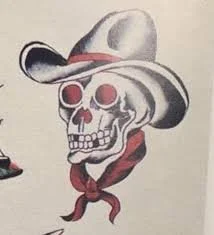
Tom Berg flash design of the famous skull
Then there is the early Tom Berg design dated 1910, which raises even more questions. The date seems hard to verify, but if authentic, it suggests that this design may have existed decades before the book printing. That would complicate the current narrative.
The difficulty is documentation. We have a clear printed example from 1937. We have oral history and scattered flash references from Coleman, Grimm, and others, and we have a disputed early photograph attributed to Berg.
What I’m not seeing is a fully documented chain from 1910 through mid-century flash to Polito.
It is possible the book cover popularized an existing motif, as skeleton designs were popular from the mid 1800s on in pop culture. It’s also possible the illustration from Death on a Dude Ranch, became the template that tattooers later adopted. Several early examples in American tattooing show line-for-line borrowing and adaptation from book cover into flash. Both scenarios seem to remain open.
Death on a Dude Ranch and the Line-for-Line Match
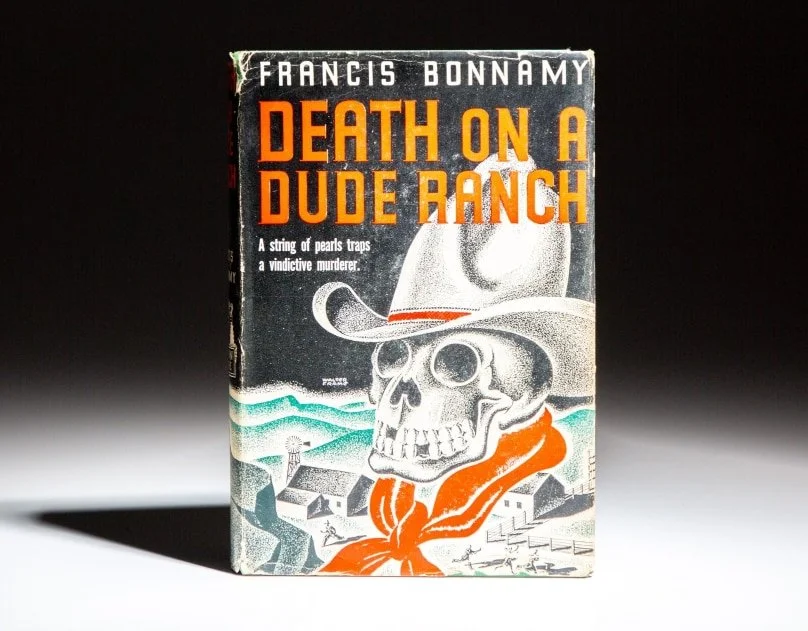
a collectible crime-fiction title; first-edition copies turn up with dealers in the low hundreds
One of the clearest documented visual sources for the design, it appears on the 1937 book cover Death on a Dude Ranch.
The book was written by Audrey Boyers Walz (1906–1983), an American woman who published crime fiction under the male pen name Francis Bonnamy. The cover illustration was created by commercial illustrator Walter Frame.
When comparing the book cover to later tattoo flash versions, the composition is so close almost identical. The angle of the skull, the tilt of the hat, the bandana placement, and the structural proportions align closely. It is not a loose thematic resemblance. It is a near line-for-line match.
If a printed, dated 1937 example exists with a documented illustrator, it becomes the earliest clearly verifiable visual anchor for this specific drawing.
This does not eliminate the possibility of earlier Western skull designs circulating in popular culture that may just be unknown or lost. It might establish that the version most tattooers recognize today mirrors a crime-genre book cover rather than a late-19th-century military image.
The paper trail begins in print. The flash comes later.
The Dr. Louis Crusius Question and the Rough Rider Paradox
Some have asked whether the design traces back to an earlier illustrator, Dr. Louis Crusius (1862–1898), and his Rough Rider drawing. This is where it gets interesting.
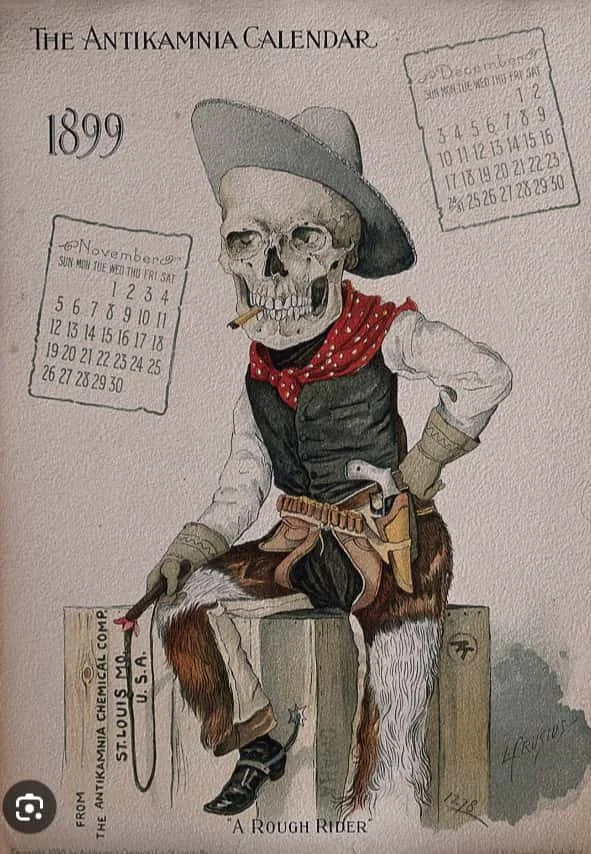
Dr. Louis Crusius rough rider illustration, is this the original source?
Crusius drew a series of skeleton illustrations for the Antikamnia Calendar in the late 1890s. His skeleton-cowboy lithograph, published in the Antikamnia Calendar, is titled “A Rough Rider”. So both the skeleton-cowboy theme and the name were sitting together in American print culture as early as 1899, decades before the book cover, and long before Polito.
That does not prove a direct line to the version tattooers use today. The design most of us recognize still matches the 1937 Death on a Dude Ranch cover almost exactly, closer than it matches the Crusius piece. But it does mean the name and the theme were already linked well before either reached tattooing.
Here is how I read it.
The phrase "Rough Rider" was culturally established in the late 1800s. Crusius put the name on a skeleton cowboy in 1899. The skull drawing that tattooers actually copy appears in print in 1937. Polito is documented using the name decades after that.
So maybe the book cover did not invent this motif. Maybe it revived an older one that was already floating through calendars, pulp art, and popular illustration. I do not think this is a clean single-source story. It looks like more than one stream feeding the same design, and the name may have traveled a different path than the drawing.
That does not take anything away from Polito. He refined the version that stuck and gave it the name that stuck. It just means the roots run deeper and messier than one book cover.
The image and the name both have history. In tattooing, they came together.
Frequently Asked Questions
-
Yes. They refer to the same skull-with-cowboy-hat design. "Rough Rider" is the traditional tattoo name used by Tony Polito. "Crazy Sal" comes from media coverage in 1980.
-
No. The motif predates Polito. He refined a version that became widely recognized in New York tattooing.
-
Polito’s use of the name "Rough Rider" clearly invokes the cultural meaning of being a rough rider. Someone who lives hard, rides hard, and accepts the consequences of that life. The phrase itself can be associated with the Roosevelt’s Rough Riders.
-
There is no evidence the design was originally created as an anti-police symbol. However, after the 1980 crime and the widespread press coverage, the image inevitably absorbed that association for some. The "Crazy Sal" story may have given the skull an ACAB edge. Even though that meaning developed after the fact.
-
I tattoo this design at Remington Tattoo in North Park, 3009 Myrtle Ave. Walk in Wednesday through Saturday, or book an appointment.
Timeline Summary
1930s: Skull-with-cowboy-hat appears on cover of Death on a Dude Ranch
1940s–1950s: Circulates in traditional tattoo flash.
1959 onward: Tony Polito tattoos and refines the design in Brooklyn.
1980: many start calling it the "Crazy Sal" after a high-profile case.
2021: Jonah Hill got the design on his forearm, tattooed by Bert Krak at Smith Street Tattoo in Brooklyn, NY
Today: Both names circulate, but "Rough Rider" seems to be the one that Polito preferred.
Research Summary
The design known as the Rough Rider tattoo was used by Brooklyn tattooer Tony Polito before 1980. The nickname “Crazy Sal” originated from newspaper reporting after the arrest of Salvatore DeSarno. The image itself predates the crime and appears in earlier American pulp art and traditional tattoo flash.
Tattooing the Rough Rider Today
I keep a hand-painted version of this design in my flash at Remington Tattoo. When I tattoo it, I build it the way it was meant to be built: bold outline, heavy black in the hat and eye sockets, and enough open skin to let it breathe. The design holds up best at six inches or larger. Any smaller and the bandana detail closes up as it ages. Chest and forearm are the classic placements. Sal wore it on his chest. Jonah Hill wears it on his forearm. Both read clean because the design was drawn to sit flat and bold.
Closing Thoughts
I am not a historian. I am a tattooer who is passionate about traditional American tattooing and its history.
There are undoubtedly others who know more, who have seen original flash, or who hold pieces of the story that are not widely documented.
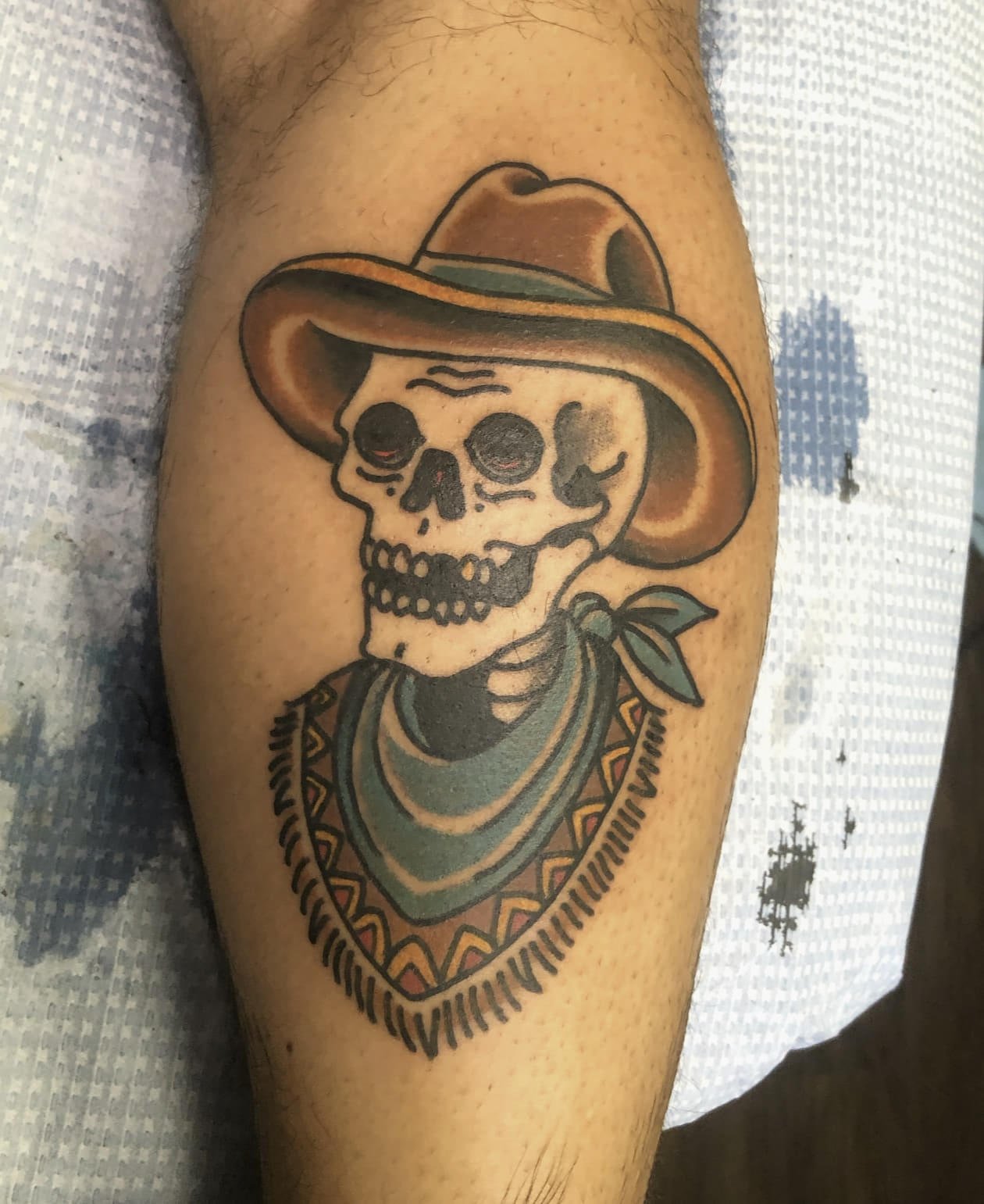
a variation of the design I put on a client a few years ago
If you have information, images, corrections, or first-hand knowledge you would like to share, I would genuinely welcome it. The goal is not to claim authority, but to keep researching, documenting, and preserving the lineage of traditional American tattooing as accurately as possible.
There is also a larger question worth asking. Without Tony Polito refining and naming it the Rough Rider skull, and without the public shock of the Crazy Sal story, would this design be as widely recognized today? Regardless of its earlier lineage, those two moments amplified its reach. Sometimes history is not only about origin. It is about impact.
Sources:
Death on a Dude Ranch first-edition record, thefirstedition.com
the 1899 "A Rough Rider" lithograph by Louis Crusius, Wellcome Collection; Antikamnia Calendar records, Smithsonian Cooper Hewitt
DeSarno sentencing, UPI, April 15, 1981; the 1980 custody photo, originally New York Daily News.