
I love tattooing tigers. Always have. I've been tattooing since 1998, the last twenty-plus years here in San Diego, and a Japanese tiger tattoo is still one of my favorite things to draw, paint and put on skin. This one started as a color study on watercolor paper and came out a lot bluer than I planned. We'll get to that.
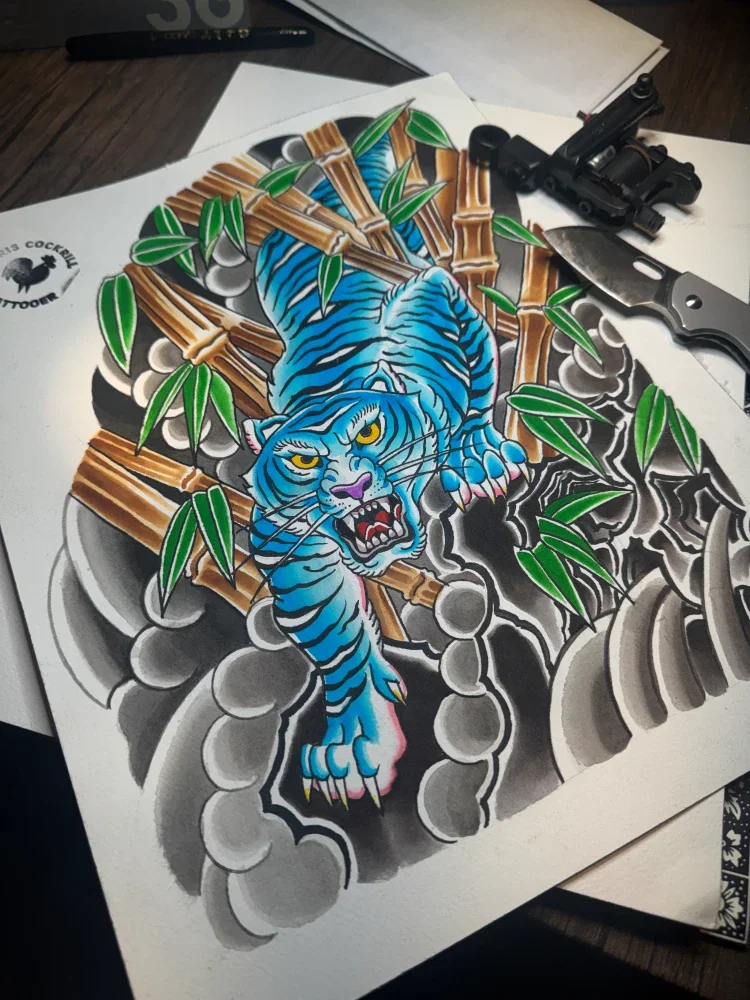
A Maltese tiger, or a white tiger gone cool. Bamboo, clouds and a lot more blue than I planned.
The tiger in Japanese tattooing
Fun fact: there have never been wild tigers in Japan. Japanese artists learned about them secondhand, through stories, paintings and goods coming over from China and Korea. A lot of old Japanese tigers were drawn by people who'd never laid eyes on one. That's why some of the faces in old prints look a little like a grumpy house cat. I love that about them.
In irezumi, the Japanese tradition of large-scale tattooing, the tiger (tora) sits right up there with the dragon for raw power. Its roar was said to scare off evil. That's why so many tigers are drawn mouth open, mid-snarl. It's not just attitude. It's protection.
Japanese tiger tattoo meaning
Strength, courage, protection from evil and bad luck, and good fortune. A tiger is a guardian. Most folks who come in asking for one want something that says "don't mess with me" and "I've got your back" at the same time. The tiger does both.
What tigers pair with: bamboo, rocks and water
A tiger rarely shows up alone. The classics:
Bamboo. The traditional partner. It bends in a storm and doesn't snap, so you get strength plus resilience.
Rocks and cliffs. Tigers climbing down a rock face show off the body and give the design movement.
Water. Ties back to the dragon side of the story and fills background beautifully.
Clouds and wind. Great for moving the eye across a sleeve or back piece.
You'll also see tigers with the dragon, with Shoki the demon queller, or with a samurai. I've done tiger and dragon back pieces and tiger and samurai sleeves, and the background is what makes them work. It lets the tiger flow with the body instead of floating there.
So, what's up with the blue tiger?
Honest answer first: I was trying out some markers that were new to me, and the blue hit harder than I expected. I liked it, so I kept going.
But there's a real story behind a blue tiger tattoo, too.
The Maltese tiger

A Savage Arms ad from the early 1900s featuring “Rev. H. E. Caldwell,” the same Harry Caldwell who reported the blue tiger. Savage sent him rifles and used his tiger hunts to sell them.
The Maltese tiger is a blue-gray tiger reported in Fujian Province in southern China, mostly in the early 1900s. A missionary and tiger hunter named Harry Caldwell spotted one around 1910 and wrote about chasing it in his 1924 book Blue Tiger. Other sightings followed. No skins, no photos, no hard proof. Some think it was a rare color mutation, kind of like how white tigers happen. Others think it's a tall tale that got better every time it was told. The tiger in the old Savage ad was a South China tiger, the same kind. Different times. They're now thought to be gone from the wild.
Either way, I think the Maltese tiger is a perfect fit for Japanese tattooing. The whole tradition was built on tigers people had only heard stories about. A blue tiger nobody can prove exists fits right in.
Or call it a white tiger that wandered into the cool end of the palette. I won't argue.
Why I paint studies off the skin
These watercolor studies do a few things for me:
Work out the design. Composition, flow, how the bamboo crosses behind the tiger. All solved on paper first.
Practice. Painting keeps my hands sharp. Twenty-five-plus years in, I'm still learning.
Test color. Like this blue. Much better to find out on paper than on somebody's arm.
Show what's possible. A finished study lets you see how a tiger like this could sit as a sleeve or back piece before you commit to anything.
Getting a tiger tattoo in San Diego
I work out of Remington Tattoo, a quiet studio on Myrtle Ave in North Park. Tigers work great as a half sleeve, full sleeve, thigh piece or back piece, and bigger gives the tiger room to breathe. If you're curious about other Japanese imagery, my Hannya mask post digs into another classic.
For more of my Japanese work, check out my Japanese tattoos page. Consultations are free and preferred, and I'll take walk-ins when the schedule allows. Bring a tiger idea. I'd be happy to draw it.
Symbolism background drawn in part from Waboripedia: The Meanings and Stories Behind Japanese Tattoos by Jean Gonzalez.