
Would you get a free Japanese bodysuit if you had to give up your skin when you died?
That's a real deal a doctor in Tokyo offered, and the result is one of the strangest collections in tattoo history: around 100 pieces of preserved tattooed skin, still held at the University of Tokyo. I made a short animated video about it, and I wanted to give the story some more room here.
Who was Dr. Fukushi?
Masaichi Fukushi (1878 to 1956) was a pathologist and professor at Nippon Medical School in Tokyo. He started out studying syphilis, and he noticed something strange: the disease seemed to leave tattooed skin alone. Syphilis sores would show up on a patient's body, but not where they were tattooed. It looked like tattooed skin had some kind of resistance to it.
That got him hooked. By the 1920s, Japanese tattooing was his main focus.
As an American, my first thought was Silence of the Lambs or Ed Gein. But Fukushi's story is different. This wasn't about horror. It came from a real love and fascination with tattooing.
It seems he wanted the work to live on longer than tattoos usually do. A tattoo lasts one lifetime. He wanted these to last like a painting or a woodblock print, long after the person and the artist were gone. As a tattooer, I get that. We spend our whole careers making art that's guaranteed to disappear.
The deal
According to the book I'm reading from in the video, Fukushi built a close relationship with Horiyoshi II and often worked at a charity hospital. He paid for people to finish their tattoos on one condition: he could keep their skin after they died.
A full Japanese bodysuit takes years and costs a fortune, so for a lot of working people, that was the only way they'd ever finish one.
What happened to the preserved tattooed skin
Fukushi performed autopsies and worked out his own method for lifting the upper layer of the skin and preserving it. Over the years he built a huge archive of skins, around 3,000 photographs, and extensive notes on how tattooing affects the body.
According to Tattoo Time and Ed Hardy's Wear Your Dreams, the photographs and records were kept in one place and the skins in another. The 1945 Tokyo air raids destroyed the building with the photos and notes. The skins were stored somewhere else, and that's why about 100 to 105 of them survive today.
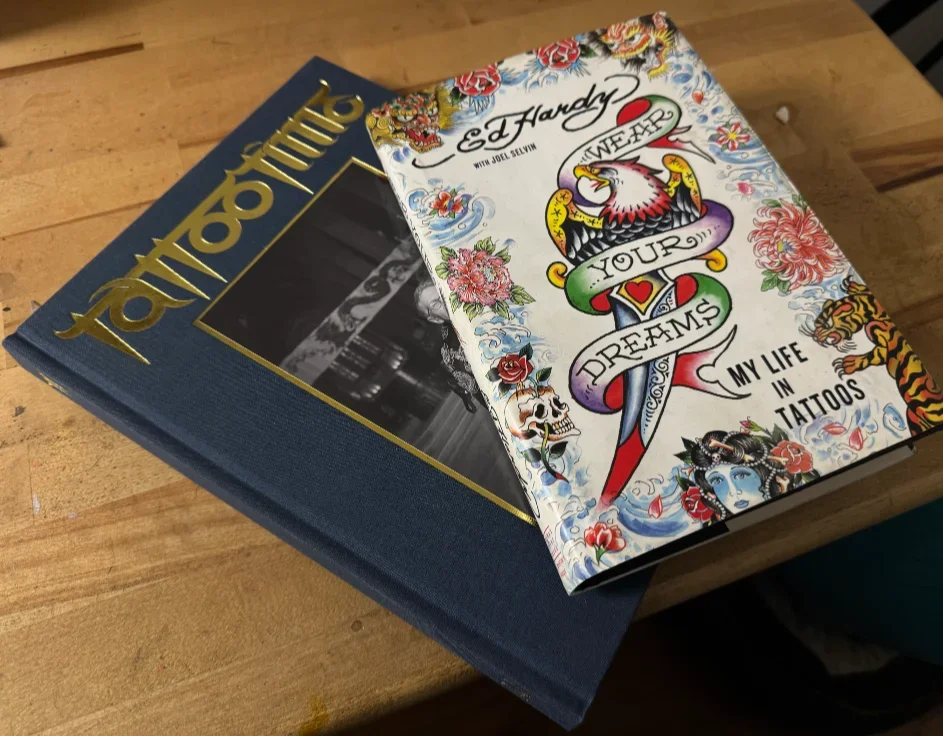
My sources: Tattoo Time and Ed Hardy’s Wear Your Dreams. Both are worth tracking down if you love tattoo history.
His son, Katsunari, became a pathologist too. He traveled around Micronesia and added about 20 more skins to the collection. Father and son were both known in Japan as "Irezumi Hakase," Dr. Tattoo.
The collection is held at the University of Tokyo's medical pathology museum. It's not open to the public, so don't plan a trip around it.
There may be a bigger collection in the UK, around 300 pieces, but those are mostly smaller, undocumented pieces of skin, not full bodysuits like Fukushi's.
Ed Hardy and the Christmas card
Ed Hardy tells this story in his memoir, Wear Your Dreams. He visited in 1983 and held one of the skins, still wet, straight out of the vat. Mrs. Fukushi took his photo, and he figures the family was a little unhappy when he used it as his Christmas card that year. Classic Ed.
Making the video
The video is a talking head of me, animated. I started with a drawing of myself in a King of the Hill style, then redrew it in Illustrator so every part could move on its own.
Getting it to talk took some work. I laid out all 12 mouth shapes, one for each group of sounds, plus eye blinks. That's about 27 layers just for the talking head. Then I animated it in DaVinci Resolve, matching the mouth shapes to the audio.
It's been quite a process bringing him to life, and this story felt like the right one to try it on. It's weird, it's real, and it says a lot about how seriously Japan takes the bodysuit as an art form.
So, would you take the deal?
I'll be honest: a free bodysuit is a strong offer. But I'd rather you keep your skin and let me do the work the regular way. If you're thinking about a Japanese sleeve, back piece or full bodysuit, check out my Japanese tattoos page or come see me at Remington Tattoo in North Park. You can also read about another classic of Japanese tattooing in my Japanese tiger tattoo post.
Subscribe on YouTube for more tattoo history.