
Rose of No Man's Land Tattoo: History and Meaning
I'm Chris Cockrill, a tattoo artist at Remington Tattoo in North Park, San Diego. I've been tattooing since 1998, specializing in traditional American and Japanese work. I recently painted my own version of the Rose of No Man's Land tattoo, and it got me thinking about where this image actually came from. There's a lot of vague information out there about this design. The history is specific, traceable, and worth getting right.
This is not a general nurse tattoo. It has a direct origin. And the women it honors were real.
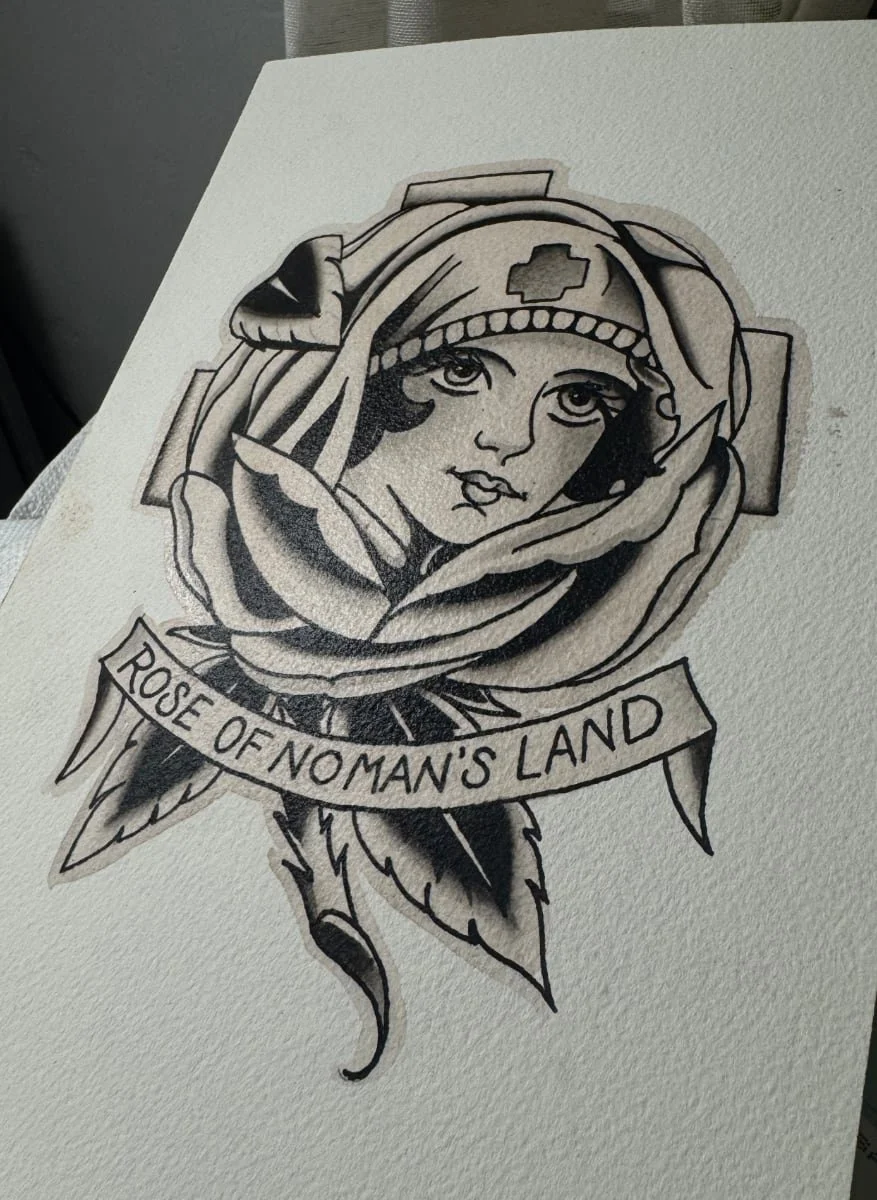
Rose of No Man's Land — flash painting by Chris Cockrill, Remington Tattoo, North Park San Diego.
A Song from 1918
In 1918, two Tin Pan Alley songwriters named Jack Caddigan and James A. Brennan published a song called "The Rose of No Man's Land" through the Jack Mendelsohn Music Company in Boston. It was an immediate hit on both sides of the Atlantic. Being translated to several languages. The song framed the Red Cross nurse as a rose growing in the most desolate place imaginable: the bombed-out strip of nothing between opposing trenches where men were wounded and dying and nobody was supposed to survive.
The song was performed widely in the US and Britain. The most well-known American recording was cut by Henry Burr in 1918 on OKeh Records. Burr, whose real name was Harry McClaskey, was one of the most recorded artists of the early phonograph era with an estimated 5,000 recordings to his name. His voice was everywhere in those years, and this song was one of his best-known recordings.
You can hear the original 1918 recording here:
Listen to it once and you understand why it moved people. This wasn't a song written at a safe distance from the war. The people buying the sheet music had sons, brothers, and husbands in those trenches.
The Cover That Became the Tattoo
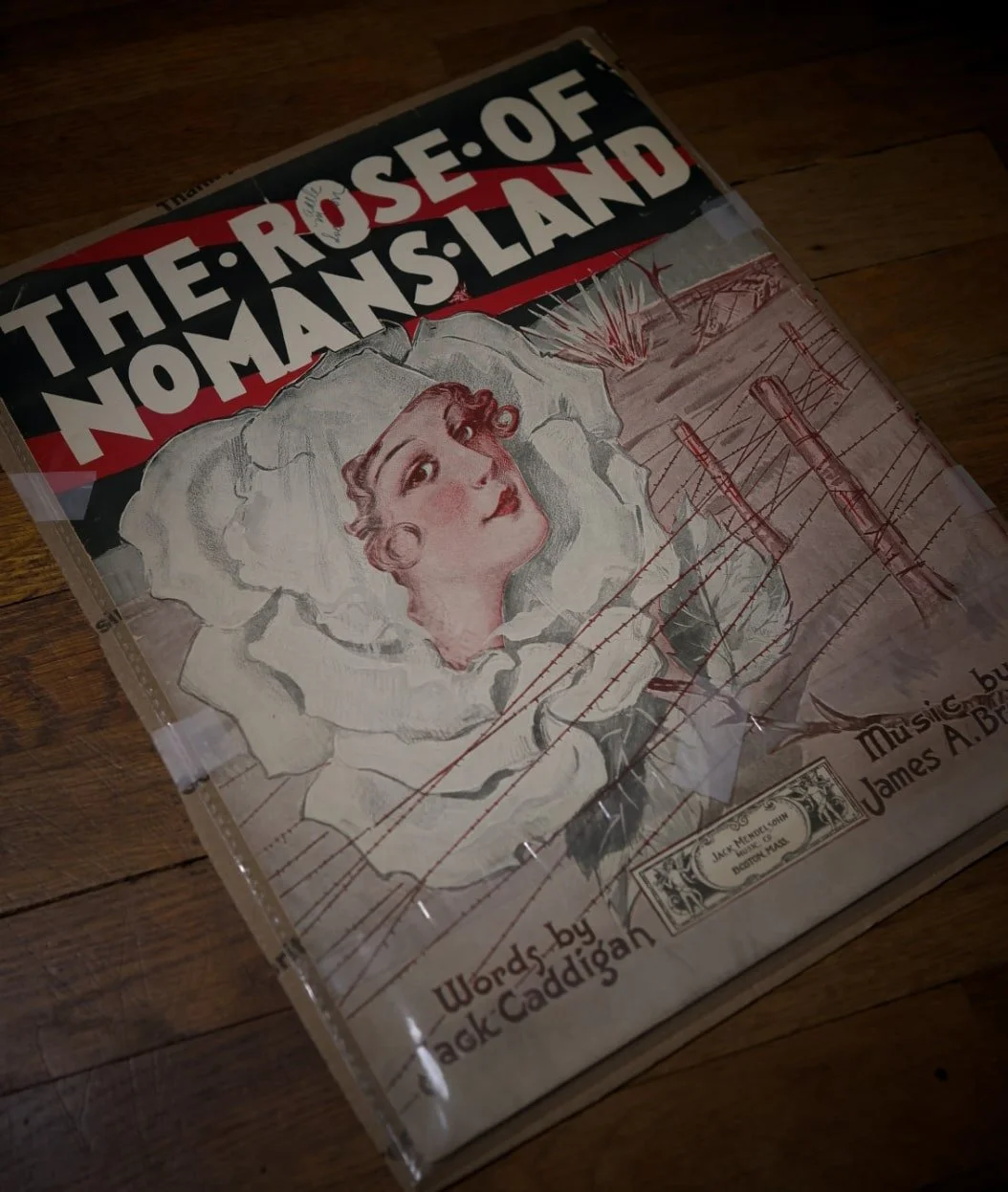
Original 1918 sheet music for The Rose of No Man's Land, words by Jack Caddigan, music by James A. Brennan, published by Jack Mendelsohn Music Co., Boston.
The sheet music cover published by the Jack Mendelsohn Music Co. in Boston is, as far as I can tell, the actual reference image that worked its way into American tattooing. Words by Jack Caddigan, music by James A. Brennan, printed and distributed by Mendelsohn out of Boston. I recently found an original 1918 copy for $9 which will soon be framed. It's well worn, someone even wrote in the letter O in the word Rose, which tells you this was actually used and handled by someone living through that era. That kind of thing adds to it rather than taking away.
The illustration shows a nurse's face nestled inside a white rose, set against a landscape of barbed wire and shell explosions. The artist was never credited, which was standard practice for commercial illustration in that era. The image is specific and deliberate: not just a woman and a flower, but a portrait inside a bloom, the petals framing her face like a saint's likeness. Behind her is a wasteland. The contrast is the whole point.
By the 1920s, Detroit-based tattoo supplier Percy Waters had this design in his flash catalog. Waters was one of the most influential figures in early American tattooing, and his catalog reached shops all over the country. That is the direct line from sheet music to tattoo shop wall. Someone saw that cover, drew it for flash, and Percy Waters put it in front of working tattooers nationwide. I have the original Percy Waters flash design at the shop, and the connection to that sheet music cover is unmistakable. That said, Waters was primarily a supply company, and a design this popular would have circulated well beyond any single catalog. Different artists were likely producing their own versions independently. It is not unlike how images move through social media today: popular culture spreads fast, artists respond to what they see, and someone figures out how to monetize it. Percy Waters just happened to be that someone in the tattoo world.
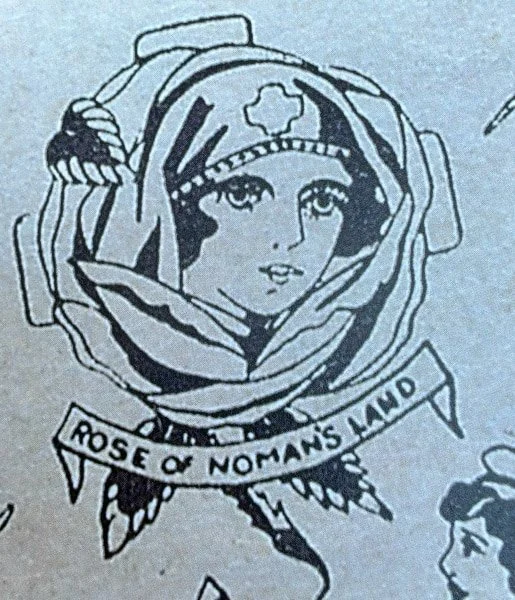
Rose of No Mans Land from the Percy Water tattoo flash catalogue
The Women the Song Was Written About
It is easy to look at this design as a piece of nostalgia. It is not. The women it depicts were doing something genuinely dangerous.
Over 18,000 Red Cross nurses served with the Army and Navy Nurse Corps during World War I. Military leaders initially kept nurses far from the front, but they learned quickly that men died from wounds that could have been treated if there had been someone closer. Casualty clearing stations were set up close to the front lines, and nurses were the ones staffing them. They worked 14 to 18 hour shifts. They were present during air raids, shelling, and gas attacks.
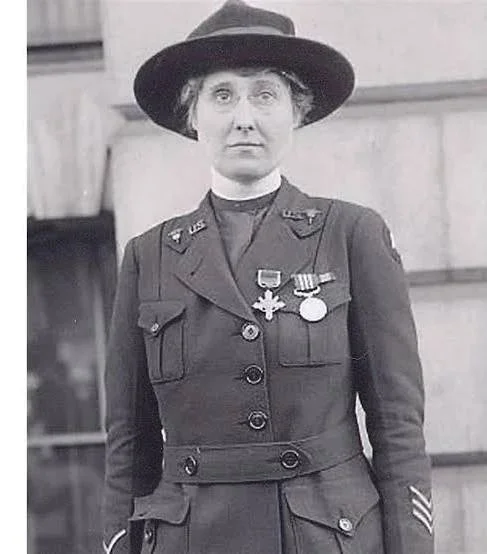
Army Nurse Beatrice Mcdonald
Army nurse Beatrice MacDonald was on duty at a casualty clearing station when an air raid sent shrapnel through her eye. After being evacuated, she refused orders to go home. She stayed in France until after the armistice, with one eye, and was awarded the Distinguished Service Cross. Cora Elm and Charlotte Edith Anderson, both Native American nurses, served on the Western Front caring for American, French, British, and Canadian soldiers under conditions that were relentless. Helen Boylston ran between wards during bombings and later wrote about it with the kind of clarity that only comes from having actually been there.
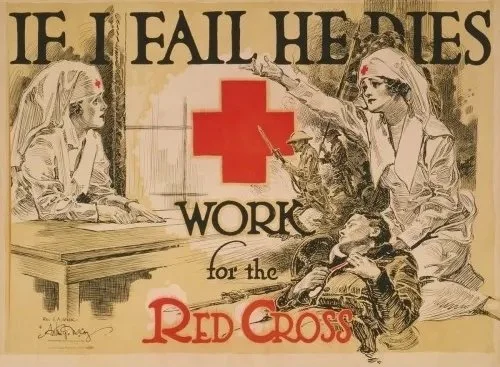
A vintage Red Cross Poster
Over 400 American Red Cross workers died between 1914 and 1921. The nurse in that sheet music illustration represented something real to the soldiers and families who bought it. That is why the image lasted.
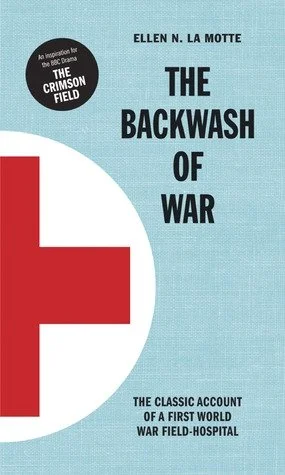
the 1916 book from Ellen Lamotte
If you want a first-hand account that goes further than the sentiment of the song, Ellen LaMotte's The Backwash of War (1916) is worth reading. LaMotte was an American nurse who served on the Western Front and wrote about what she saw honestly enough that the book was suppressed in the US during the war. It may be the other side of this story.
The Chorus
The lyrics to the chorus of this song have stayed with me since I first read the sheet music:
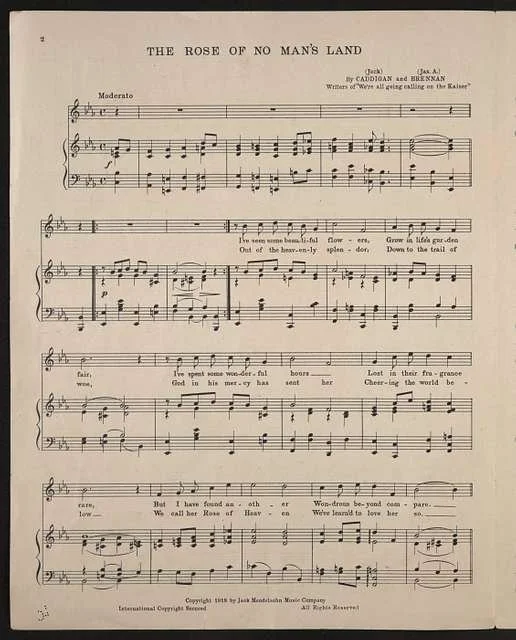
"Tho' its spray'd with tears, it will live for years, in my garden of memory."
That is, whether the songwriter intended it or not, a description of what a tattoo does. It holds grief and love together in something that lasts.
And the plainest line in the whole song:
"'Mid the war's great curse, stands the Red Cross Nurse."
After several verses of ornate, sentimental language, they got to something true and just said it straight.
Something Personal
My great-grandmother was a nurse here in the United States during this time, caring for patients with the Spanish flu as it spread through the country carried back by returning soldiers. She never went to war. The war came to her. She died at 24 years old, leaving behind a four-year-old daughter: my grandmother, who grew up and became a doctor.
The 1918 influenza pandemic killed more people than the war did. Nurses were 50 percent more likely to die from it than doctors, because they were the ones in the rooms with the sick. Over 3,600 healthcare workers died in the first year of the pandemic alone. You didn't have to be on the Western Front to pay that price.
My great-grandmother never got a monument. Most of them didn't. That is what this design has always meant to me: a way of remembering people who were not remembered the way they should have been.
Tattooing the Rose of No Man's Land
This piece sits at the heart of traditional American tattooing, a style built on exactly this kind of image: clear, symbolic, made to last. When I paint or tattoo this design, I am working from a specific reference with a specific history. These elements came from a real cultural moment and they carry that weight whether you know the history or not.
People come to me with this design for different reasons. Some have nurses or medical workers in their family. Some have a military connection. Some just respond to the image and then learn what it means. All of those are good reasons.
If you're thinking about this design, come in and talk about it. I work out of Remington Tattoo in North Park. Consultations are preferred, and I do take walk-ins when the schedule allows. We can talk about placement, size, and what version of this image fits you.
Chris Cockrill has been tattooing since 1998. He works at Remington Tattoo, 3009 Myrtle Ave, North Park, San Diego CA 92104. Wednesday through Saturday, noon to 7pm.