
Traditional Tattoo Flash: Why I Still Paint It by Hand
I've been painting tattoo flash for years. Partly because it's a good way to work out new tattoo designs, but mostly because I just enjoy doing it. There's something relaxing about sitting down with a sheet of paper, a nib, some brushes, and a pile of ideas.
Flash isn't really one specific style of tattooing. It's more of a format. A sheet of designs made to be tattooed. You can paint traditional tattoo flash, Japanese designs, black and grey, fine line, or just about anything else.
I keep coming back to American traditional tattoo flash when I'm looking for new or old ideas. Bold lines. Strong shapes. Simple ideas that read clearly. There's a reason so many of these designs have been tattooed for more than a hundred years. I'd rather learn from that than spend too much time chasing whatever happens to be popular this week.
That doesn't mean every sheet has to be eagles, roses, swallows, and anchors. Sometimes it's something more realistic, sci-fi, or even used as an underpainting for oil paint.
So there's still room to screw around.
What Is Tattoo Flash?
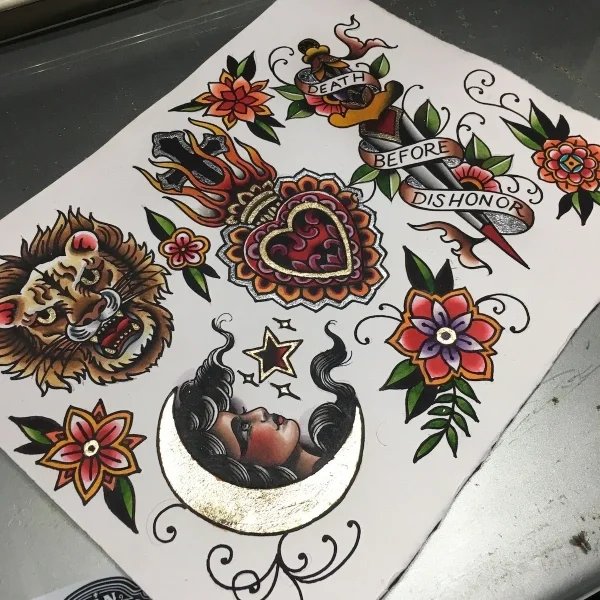
a sheet of gold leaf tattoo flash I painted
Tattoo flash is simply a collection of tattoo designs that are ready to be tattooed. Traditionally, flash sheets were painted or printed and hung on the walls of tattoo shops. You walked in, looked around, picked something you liked, and got tattooed.
The standard size has been 11" by 14", usually horizontal, for years.
For a long time, tattooers also bought, sold, and traded flash. Commercial flash could come as a finished color sheet along with a separate line drawing for making the stencil. Black-and-white sheets were also sold so tattooers could color them themselves depending on what colors they offered.
Today, flash can be just about anything. It might be hanging on a shop wall, kept in a book, posted on Instagram, or sold as a print. I still like painting mine by hand. Not because it's the only way to make flash, but because I enjoy the process.
A Little History of American Traditional Tattoo Flash
American tattoo flash developed alongside the tattoo shops, traveling tattooers, carnivals, military towns, ports, and supply businesses of the late 1800s and early 1900s. Tattooers painted designs that could be displayed, transported, traded, copied, and tattooed efficiently. Over time, certain images became part of the visual language of American tattooing: eagles, ships, swallows, hearts, daggers, roses, military designs, pinups, and plenty of stranger things.
Tattooers like Bert Grimm, Owen Jensen, Cap Coleman, Sailor Jerry, and many others helped shape what we now think of as American traditional tattooing. The more old flash you look at, the more you start to understand why the designs were built the way they were. Strong silhouette. Clear linework. Enough black to hold the design together. Nothing there just to show off. Just made precisely for the medium of paper and skin. They were tattoos first.
That's probably the biggest thing I've learned from studying old flash: how to construct a tattoo to last.
Why I Started Painting Flash
I started tattooing in the late 1990s, and old tattoo flash was a big part of learning how tattoos were supposed to work.
I've always been drawn to nautical imagery, ships, swallows, sea monsters, military designs, and all the weird stuff around the edges of tattoo history.
But painting flash also became a way to study tattooing itself. When you paint a sheet, you have to make decisions. How much detail does this actually need? Where does the black go? Does the design read from across the room? Is this going to work as a tattoo, or did I just make a nice drawing?
You can learn a lot by repainting old designs and figuring out why they work. Then you start changing things. That's where it gets fun.
The Tools I Use to Paint Tattoo Flash
I keep the setup pretty simple.
For outlining, I use a B-5 nib in a pen holder made by tattooer Sam Phillips out of recycled skateboard decks. I like handmade tools, and it feels appropriate to paint flash with something another tattooer made.
For painting, I use a No. 6 liner brush and a No. 6 filbert for spit shading.
For color, I usually go back and forth between FW acrylic inks and Dr. Ph. Martin's Hydrus watercolors.
That setup gives me the look I want without making the process overly complicated. The materials have changed over the years, and every tattooer seems to develop their own little system. Mine is just what I've settled into.
Why I Still Paint Tattoo Flash by Hand
I spend plenty of time on computers. I design digitally when it makes sense. I photograph my work, scan paintings, make prints, and use modern tools like everyone else.
But painting flash by hand is different. You can't endlessly undo everything. The little mistakes stay there. Sometimes they make the sheet better. Sometimes they just remind you not to do that again. And it's easier on the eyes.
More importantly, painting flash makes me think about tattoos. There is no undo. It forces me to simplify things. To think about line weight, shape, contrast, color, and how an image is actually going to sit on the body.
After all these years, I still think painting flash makes me a better tattooer. That's probably the real reason I keep doing it.
Tradition Is the Starting Point
I have a lot of respect for old tattoo designs, but I don't think the point is to endlessly copy the same sheet exactly as it was painted 80 years ago. You study it. You learn why it works. Then you do something with it.
Sometimes that means repainting an old design pretty faithfully. Sometimes it means changing the composition, the color, or the subject. Sometimes it means painting something that would have made absolutely no sense on a tattoo shop wall in 1940.
That's fine. Tradition gives you a foundation. It doesn't mean you have to stop there.
A Few Questions I Get
-
Usually, yeah. Most of my flash has some flexibility in size, and a lot of it can be done in black and grey or color. If you want something tweaked, tell me when you book and we'll sort it out.
-
Flash is ready to go. You pick a design that's already drawn and we can usually knock it out in one sitting, often at a flat rate. A custom piece is drawn specifically for you, so it takes more time up front. Both end up a solid tattoo. Flash is just the faster path.
-
Sure. If you've got a concept you want painted up as a sheet, I'm into it. Some of my favorite designs started as somebody else's weird idea.
Where My Flash Ends Up
Some of these designs get tattooed. Some end up framed on somebody's wall. Some sit in books or piles around my studio until I rediscover them five years later.
Lately, I've also been putting more of my traditional tattoo flash into prints, books, and zines. I like the idea of these sheets continuing to exist as physical objects instead of everything disappearing into an Instagram feed.
I'm always painting more. If you see a design you want tattooed, let me know. That's what they're for.
You can also check out my available tattoo designs or follow along on Instagram at @chriscockadoodledo to see new flash, tattoos, tattoo machines, and whatever else I happen to be working on.