
Pharaoh's Horses is one of the oldest designs in American traditional tattooing: three horse heads charging out of the water, eyes wide, manes flying. Most people know it from flash sheets. Fewer know it started as a Victorian painting, or that the Pharaoh's horses tattoo meaning goes back to the Book of Exodus. Here's the whole story.
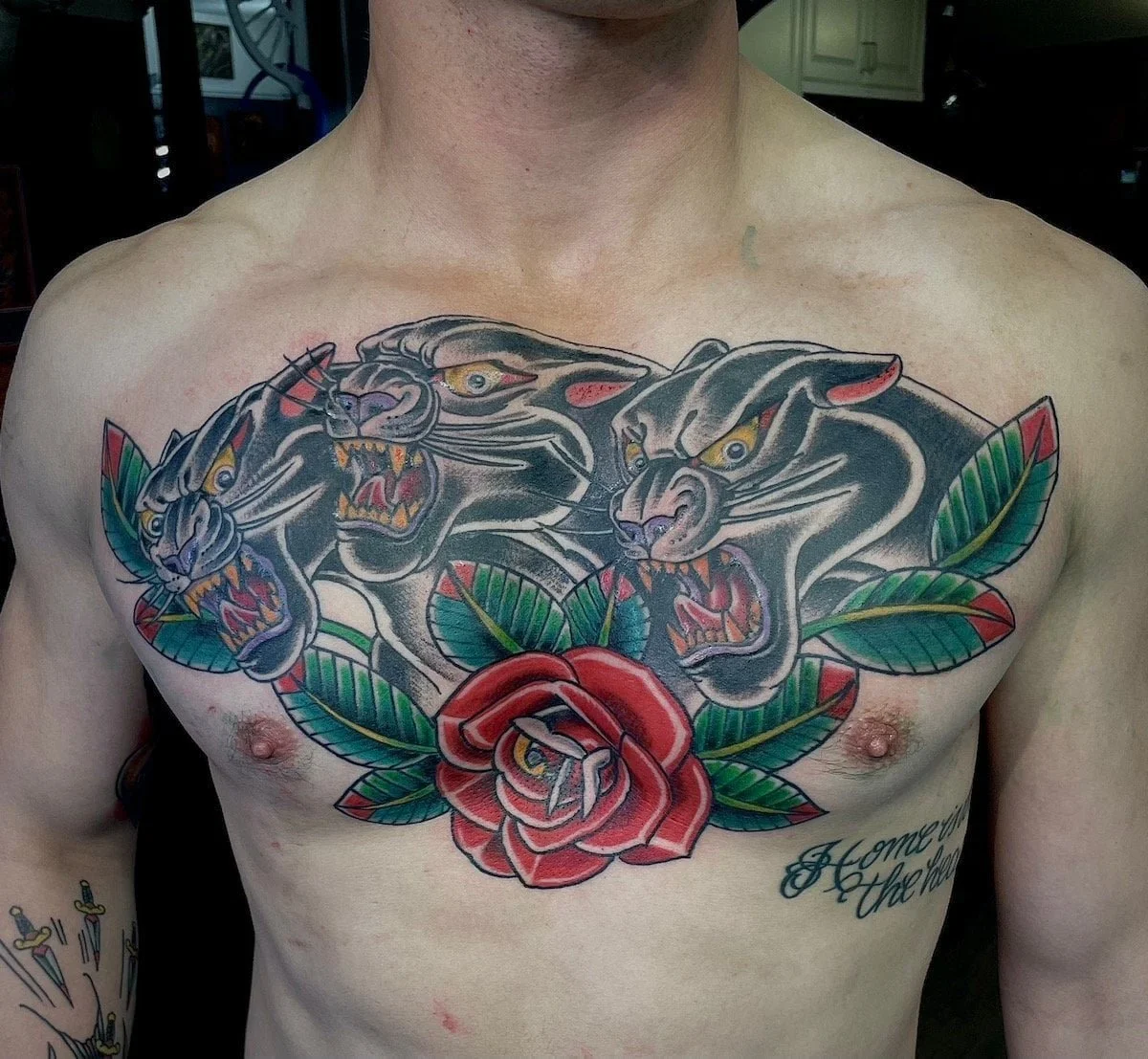
One of my favorite tattoos I've done: Pharaoh's Panthers, a twist on the classic
Where the Pharaoh’s Horses Design Comes From
Pharaoh's Horses by John Frederick Herring Sr., 1848
The design comes from an 1848 painting by John Frederick Herring Sr., a British artist known as the "artist coachman." He started out driving stagecoaches and painting horses on inn signs, and worked his way up to commissions from the Duchess of Kent and paintings for Queen Victoria herself. He first showed this one as "Pharaoh's Chariot Horses."
Here's a detail most people don't know: all three horses are the same horse. Herring used one grey Arabian stallion, Imaum, for every head. Imaum was a gift to Queen Victoria from the ruler of Muscat.
The painting blew up because of a mezzotint engraving by Charles Wentworth Wass, published in 1849. Prints ended up framed in homes all over Britain and America for the rest of the century.
There's also a darker version, with the horses charging into a stormy sea, that turned up at a Missouri flea market in 1987. Some people think it came before Herring's. Nobody's proven it either way.
How It Became a Tattoo

Gus Wagner's Pharaoh's Horses back piece
Early American tattooers pulled from whatever images people already knew, and by the early 1900s Pharaoh's Horses was everywhere. Gus Wagner, one of the pioneers of American tattooing, wore a big back piece version with an eagle perched over the horses and roses around them. Percy Waters put it in his flash catalog in 1923, and from there it became a staple on shop walls.
It was especially popular with sailors and soldiers. A design about power and the sea made a lot of sense to guys who spent their lives on the water or heading off to war.
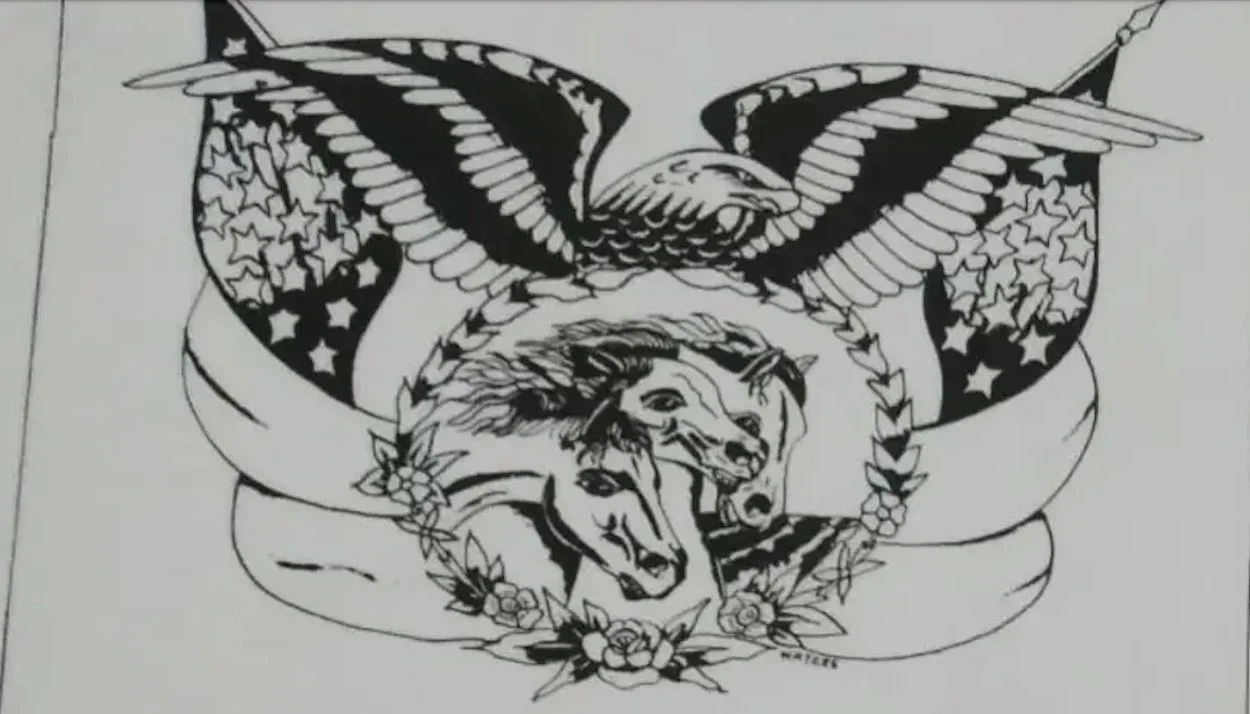
Percy Waters 1923 flash catalog Pharaoh's Horses tattoo design
Pharaoh's Horses Tattoo Meaning
The title points straight to the Book of Exodus. Pharaoh sends his army and chariots after the Israelites, the Red Sea parts to let them through, then closes over Pharaoh's men. In Exodus 15 the Israelites celebrate with a song: "the horse and his rider hath he thrown into the sea." Look at the horses' eyes in the painting. They see it coming.
So the tattoo carries a few meanings:
Strength and power. Three Arabian stallions at full charge is about as clear a symbol of raw power as you can get.
Salvation and deliverance. For a lot of people, especially sailors, it's about being carried through danger when the odds closed in.
Pride before the fall. It's a little ironic: in the story, these are the horses that drowned. Some people wear it as a reminder that no power is unstoppable.
Why Three Horses?
People ask about this a lot. The three horses come from Herring's composition. A group of three horse heads was one of his favorite setups, and he painted it many times. Some people attach their own meaning to the number three, but in the original it's an artistic choice, not a code.
Variations on the Classic
Part of what keeps Pharaoh's Horses alive is how well it takes a swap. I've done it with panthers, and you could just as easily do tigers, wolves, or even alligators. The composition is strong enough to hold almost any animal, as long as you keep the three heads, the charge, and that look of panic.
Pharaoh's Horses Tattoo FAQ
-
It comes from the Red Sea story in Exodus, where Pharaoh's horses and chariots were swept into the sea. As a tattoo it usually stands for strength, salvation, or a reminder that no power lasts forever.
-
British painter John Frederick Herring Sr. in 1848. A popular engraving of it by Charles Wentworth Wass spread the image across Britain and America.
-
Herring liked painting groups of three horse heads and used the setup often. All three horses in the painting were based on the same Arabian stallion, Imaum.
-
Yes. It's been part of American traditional tattooing since the early 1900s, with versions by Gus Wagner and in Percy Waters' 1923 flash catalog. However it can be done in other styles
Getting a Pharaoh's Horses Tattoo in San Diego
I've been tattooing American traditional since 1998 and working in San Diego since 2003. Whether you want the classic Pharaoh's horses tattoo or your own spin on it, bring the idea in and we'll build it out together.